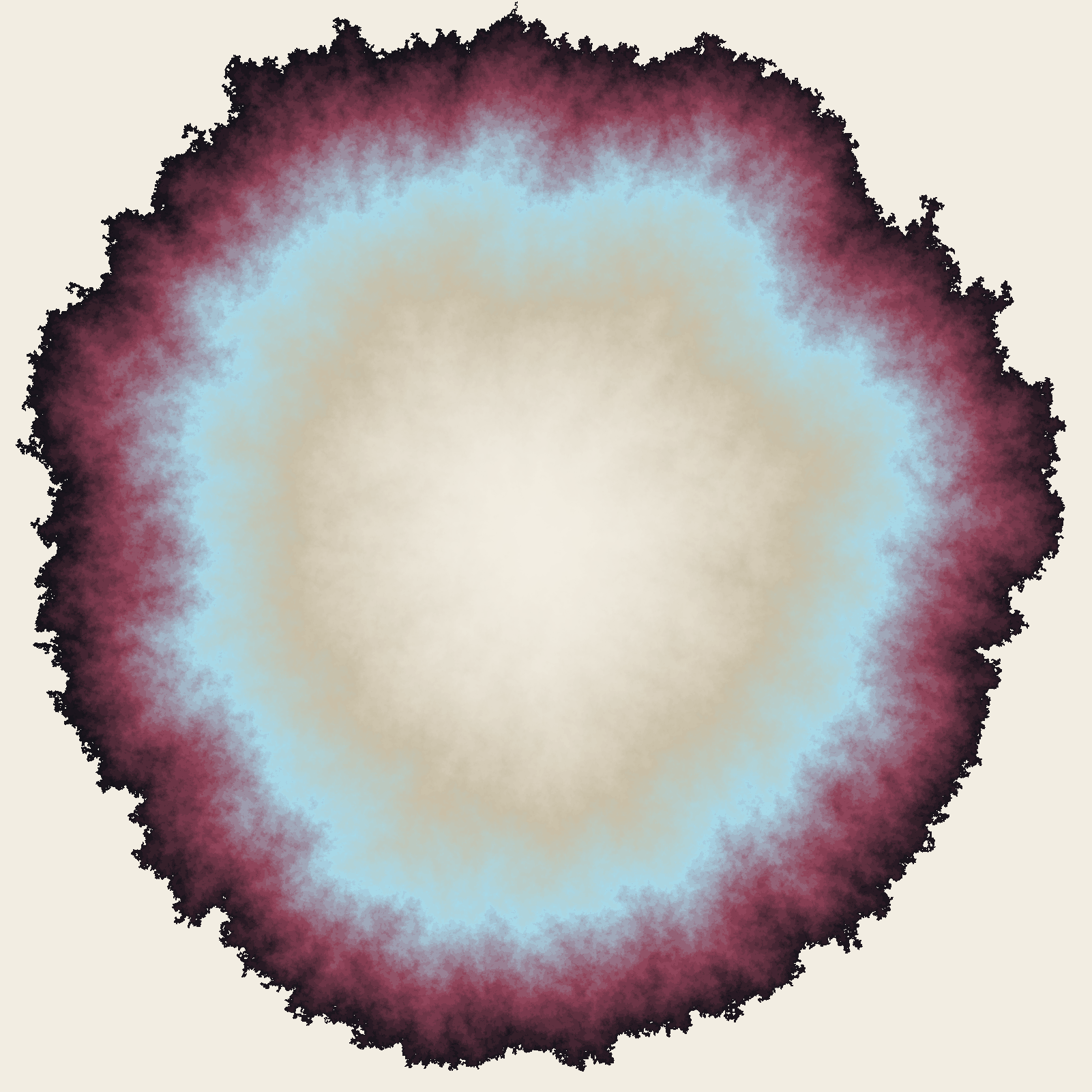
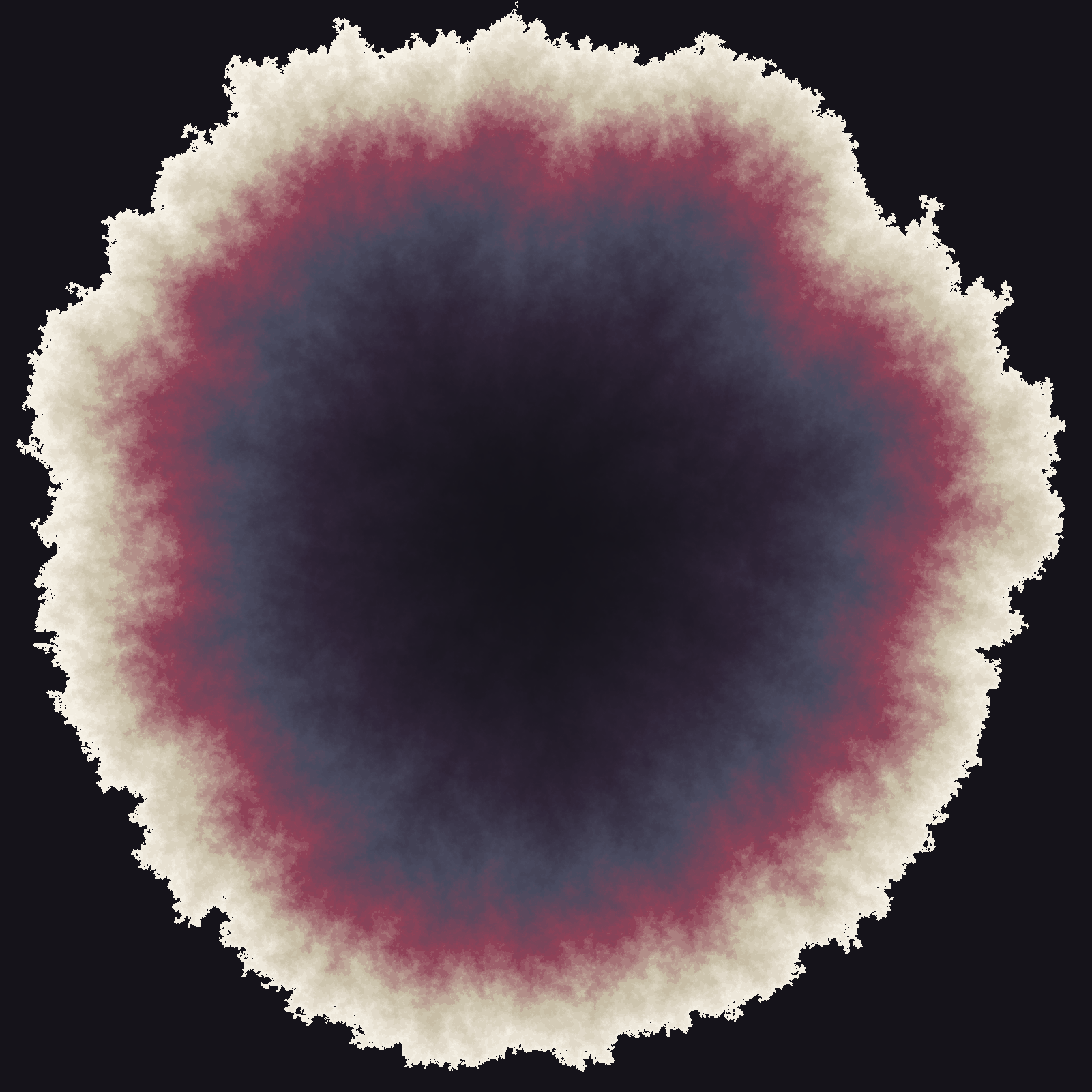
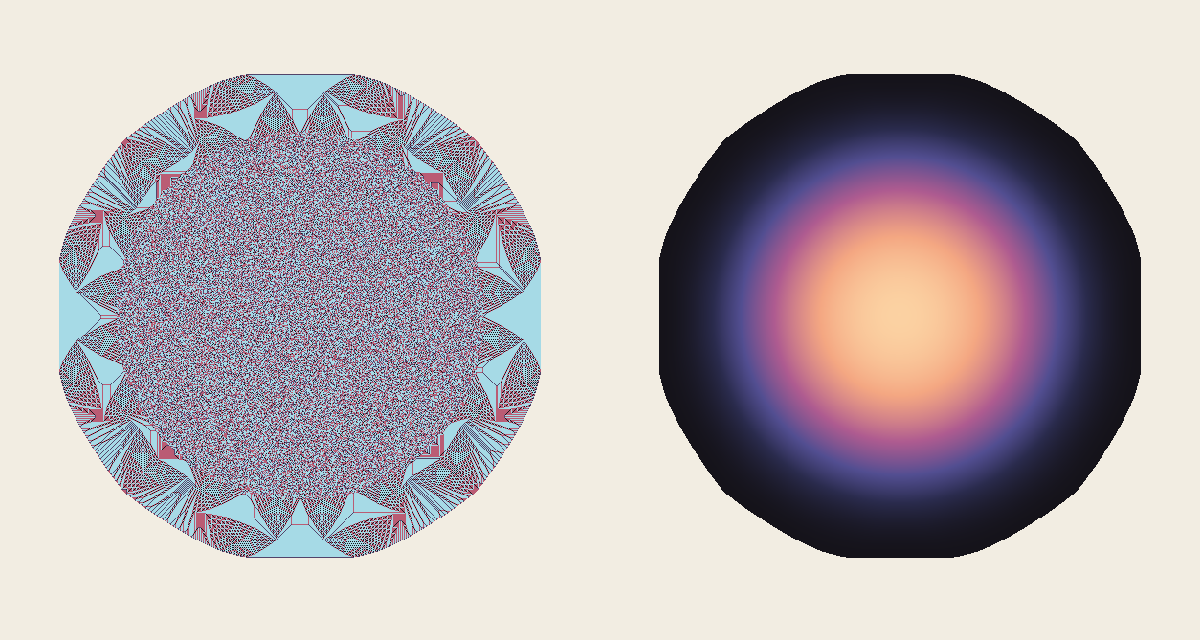
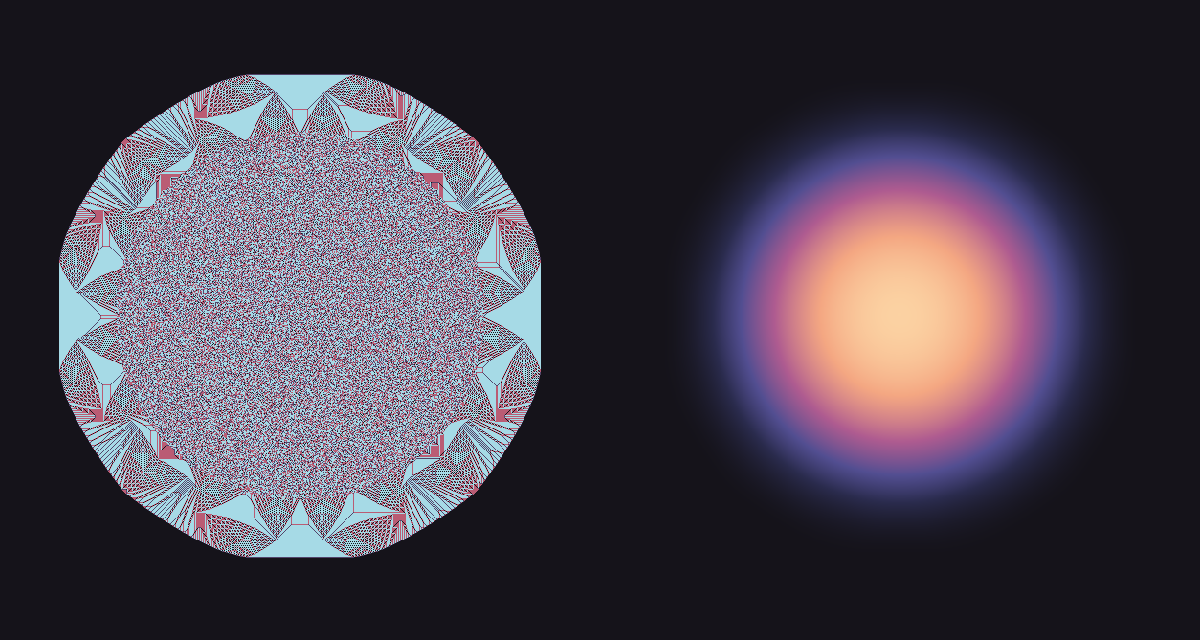
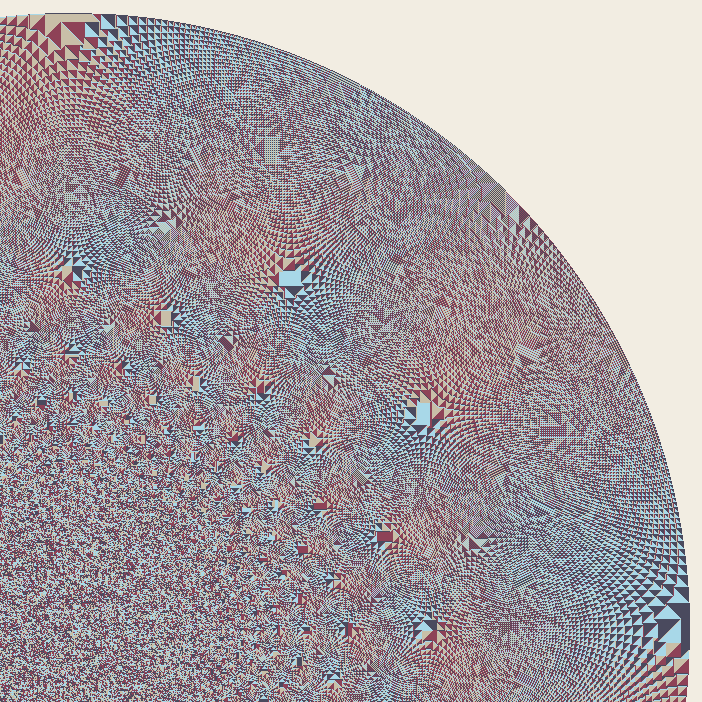
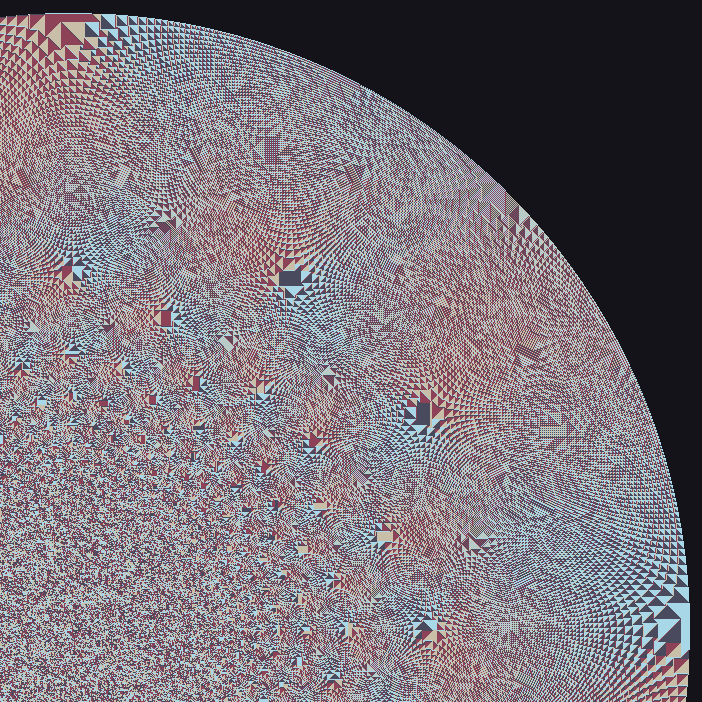
Theorem. Let \(d\ge2\), let \(W\subset\mathbb R^d\) be a bounded Lipschitz domain, and let \(\eta\) be a bounded, stationary, ergodic, integer-valued field satisfying \(\mathbf E\eta(0)>2d-1\). If \(v_n\) is the odometer obtained by putting \(\eta\) on \(nW\cap\mathbb Z^d\) and zero outside, then, with \([x]\) a nearest point of \(\mathbb Z^d\) to \(x\), \(n^{-2}v_n([nx])\) converges almost surely and uniformly to \[\bar v=\min\{v\in C(\mathbb R^d):v\ge0,\ \bar F_\eta(D^2v)\le0\text{ in }W,\ \bar F_0(D^2v)\le0\text{ in }\mathbb R^d\}.\] Here \(\bar F_\eta\) is a nonrandom, degenerate elliptic operator defined implicitly from the law of \(\eta\), \(\bar F_0(M)=\inf\{s\in\mathbb R:\text{some }u:\mathbb Z^d\to\mathbb Z\text{ satisfies }\Delta_{\mathbb Z^d}u\le2d-1\text{ and }u(y)\ge\tfrac12y^{\mathsf T}(M-sI)y\text{ for all }y\in\mathbb Z^d\}\), and the differential inequalities are interpreted in the viscosity sense. The rescaled stable configurations \(\bar s_n(x):=s_n([nx])\) converge weak-* to a deterministic \(s\in L^\infty(\mathbb R^d)\), with \(s=\Delta\bar v+\mathbf E\eta(0)\) weakly in \(W\) and \(s=\Delta\bar v\) weakly outside \(W\). (Bou-Rabee, arXiv:1909.07849, Theorem 1.1)
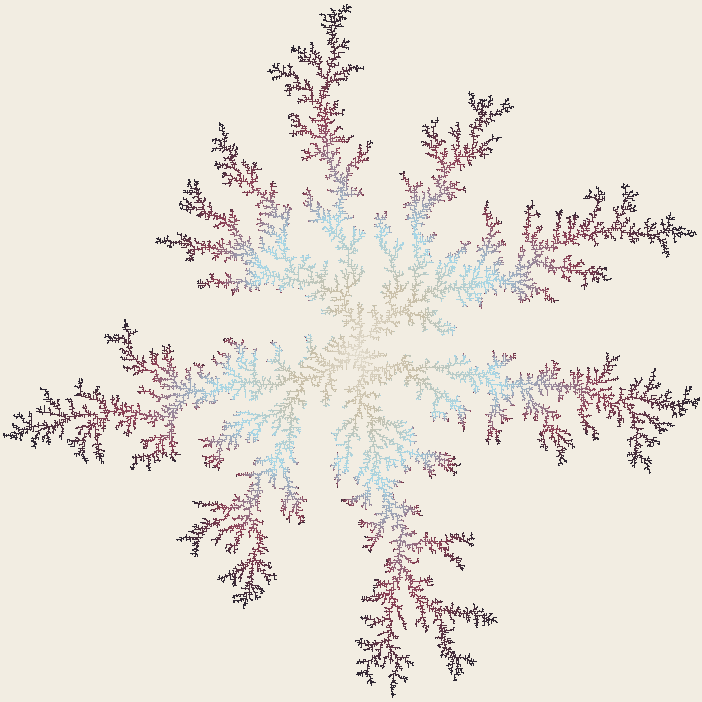
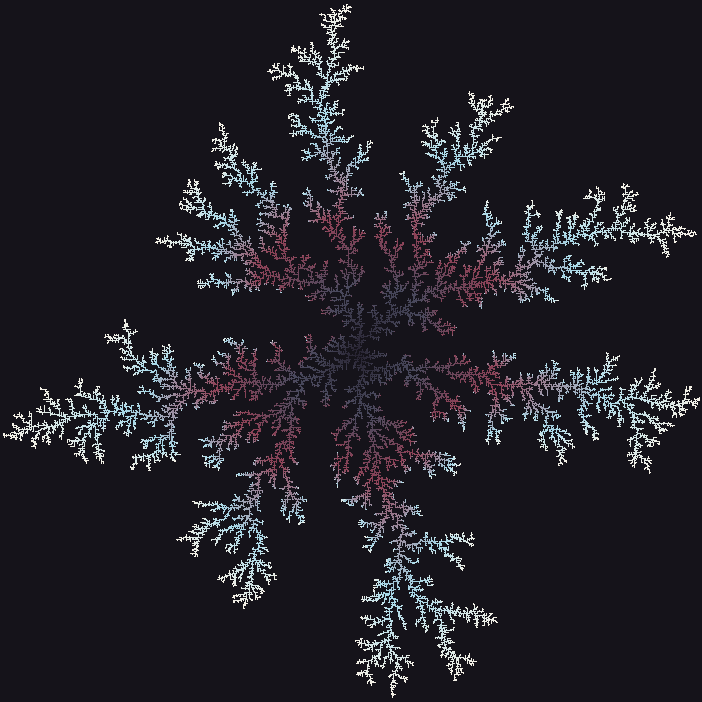
Theorem. Single source sandpile on a random background. Let \(d\ge2\), let \(\eta_{\min}\in\mathbb Z\), and let \(\eta\) be a stationary ergodic integer-valued field satisfying \(\eta_{\min}\le\eta(x)\le2d-2\) almost surely. Let \(v_n\) be the odometer after adding \(n\delta_0\), and let \([x]\) denote a nearest point of \(\mathbb Z^d\) to \(x\). Almost surely, \(n^{-2/d}v_n([n^{1/d}x])\to\bar v+G\) locally uniformly on \(\mathbb R^d\setminus\{0\}\), where \(G\) is the fundamental solution of the Laplacian in \(\mathbb R^d\), \(\bar F_\eta\) is the deterministic effective operator associated with the law of \(\eta\), and \(\bar v=\inf\{v\in C(\mathbb R^d):v\ge-G,\ \bar F_\eta(D^2(v+G))\le0\}\). The differential inequality is interpreted in the viscosity sense. (Bou-Rabee, arXiv:1909.07849, Theorem 9.2)
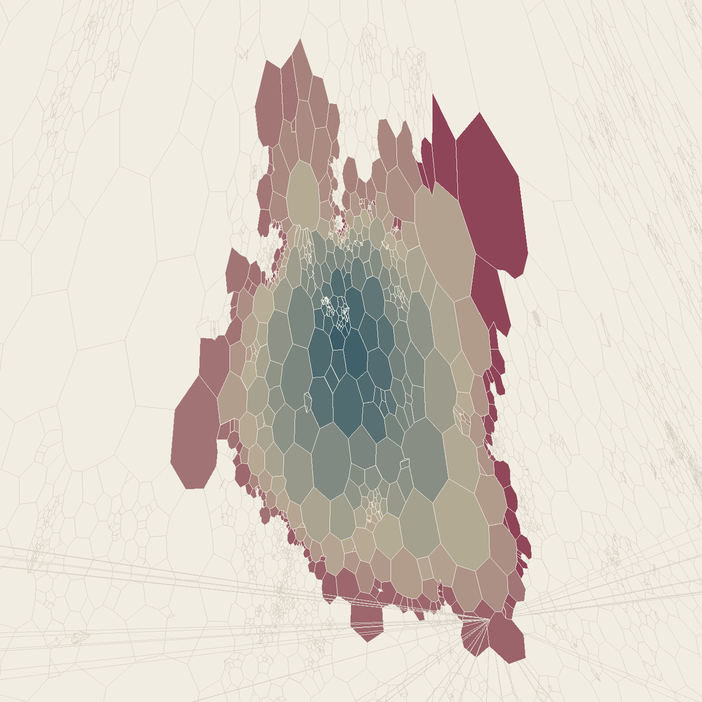
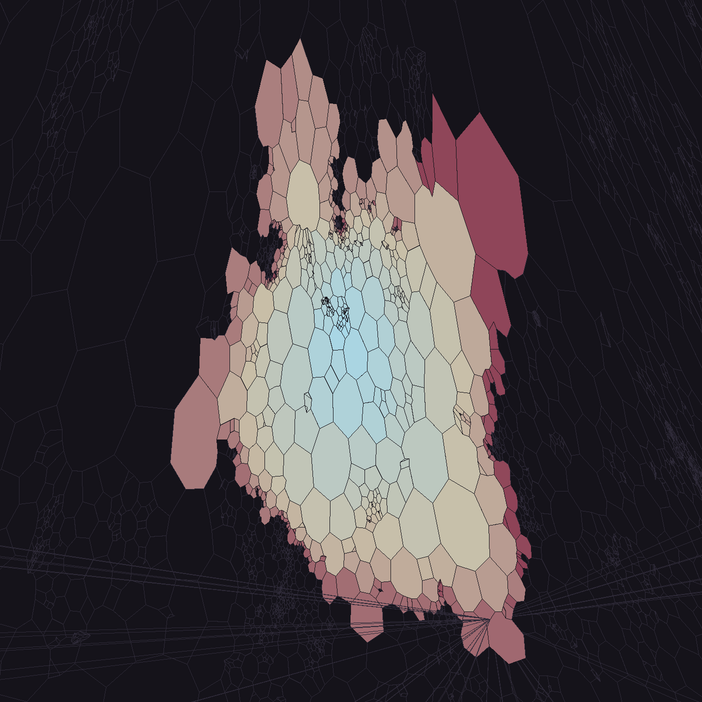
Theorem. Exploding sandpiles. Let \(d\ge2\), let \(p\in(0,1]\), and let \(\eta(x)\) be i.i.d., equal to \(2d-1\) with probability \(p\) and \(2d-2\) otherwise. Let \(M_\eta=\min\{m\ge1:\eta+m\delta_0\text{ is not stabilizable}\}\). Add \(M_\eta\delta_0\), use parallel toppling odometers \(v_t\), and set \(T_\eta(x)=\min\{t\ge1:v_t(x)>0\}\). Almost surely, \(n^{-1}T_\eta([nx])\to N_p(x)\) locally uniformly, where \(N_p\) is deterministic, continuous, convex, and one-homogeneous. Moreover, there is a convex domain \(\mathcal B(p)\subset\mathbb R^d\) such that, almost surely, \(|\{\bar v_t>0\}\,\triangle\,\mathcal B(p)|\to0\), where \(\bar v_t(x)=v_t([tx])\). (Bou-Rabee, arXiv:2102.04422, Theorems 1.2–1.3)
Question. Characterize \(\bar F_\eta\), which the first theorem defines only implicitly, in terms of the law of \(\eta\).
Details
Proof idea, first theorem. The sandpile is expressed as the solution to a nonlinear discrete PDE, and the proof follows the stochastic homogenization program of Armstrong and Smart (2014) in three steps: identify the effective equation \(\bar F_\eta\) via the subadditive ergodic theorem applied to an auxiliary Monge–Ampère measure; show that \(\bar F_\eta\) inherits the comparison principle for sandpiles; and show that every subsequential limit of the rescaled odometers is a viscosity solution.
Crossing time. Let \(Q_k=\{x\in\mathbb Z^d:1\le x_i\le k\}\) and let \(L\) be a line crossing \(Q_k\) in a coordinate direction. Run parallel toppling with the odometer frozen at 0 outside \(Q_k\) and at 1 on \(L\). If every line in \(Q_k\) parallel to \(L\) contains at least one site with \(2d-1\) grains, then every site of \(Q_k\) topples within \(k^d\) steps. Under the product measure, this event has probability at least \(1-k^{d-1}e^{-2\epsilon^2k}\) for every \(0<\epsilon<p\).
Proof idea, third theorem. A high-probability bound on the crossing time of a large cube gives a coarsened lattice with an infinite cluster of good cubes; with large-deviation bounds for the chemical distance of supercritical Bernoulli percolation, this gives uniform linear bounds on the arrival times. The arrival times are not subadditive, so the proof passes to the last-wave, an exploding sandpile in which the origin is constrained to topple a fixed number of times. The last-wave is approximated by a quantity which is exactly subadditive, and a deterministic comparison, which requires \(\eta\ge2d-2\), shows that the last-wave approximates the expanding front of the exploding sandpile.
For each \(d\ge2\), arXiv:2102.04422 (Theorem 6.1) also constructs explosive backgrounds \(\eta\not\ge2d-2\) on \(\mathbb Z^d\), random or periodic, which fail to have a limit shape: with \(T(n)=\min\{t>0:v_t(ne_1)>0\}\), \(\limsup_{n}n^{-1}T(n)\ge3/2\) and \(\liminf_{n}n^{-1}T(n)=1\).
A. Bou-Rabee, “Convergence of the random Abelian sandpile”, Ann. Probab. 49 (2021), arXiv:1909.07849; “A shape theorem for exploding sandpiles”, Ann. Appl. Probab. 34 (2024), arXiv:2102.04422. Growth and explosion in sandpiles were studied by A. Fey, L. Levine and Y. Peres, J. Stat. Phys. 138 (2010).